“The Rich Pay Less Taxes than you”
I’m sure we’ve all heard that in one form or another.
But is it true?
Honestly, yeah.
Just kidding.
This is Fast Start Finance - I’m going to tell you how they do it and how you can do it too (legally of course).
At its core, the US Tax System favors Owners over Earners.
Owners of businesses, real estate, stocks, bonds, and other assets have FAR more flexibility in how they are taxed.
Earners, people who earn an income through a normal salaried/hourly job, have a very standard approach to taxes.
This system leads to crazy facts. Did you know that Warren Buffet pays a lower tax rate than his secretary?
“Chris, I’m an earner. How can I pay less in taxes?” Read along.
So, how are Earners taxed?
Earner's income is taxed in brackets. Your first dollars are taxed at low rates, then higher chunks get taxed more.
This chart lays out the US Federal tax brackets.
Someone making $70,000 per year in Texas pays about 10.6% in taxes, but every next dollar you earn is taxed at 22%.
That’s not bad, but here’s the problem: Every dollar you earn is immediately taxed. No delay, no window for growth.
You’re also limited in the amount of deductions you have access to. Deductions are ways to reduce your taxable income and therefore reduce your taxes.
Owners Are Different
They likely still have some income, but they have more deductions to take advantage of and some of their wealth is taxed differently altogether.
Take Stocks (or any investment like an index fund, etc.). If you buy $1,000 worth of the S&P 500 in 2025 and it grows for 20 years, you don’t pay anything in taxes until you sell. That’s decades of tax-free compounding.
When you do end up selling, you pay a Capital Gains tax - NOT an Income Tax. Capital Gains tax is the tax on the growth of assets as opposed to income.
Capital Gains are normally taxed at 15% (or 20% for really high earners). Compare that to income which may have a 22-37% marginal tax rates. That’s a huge difference.
Owners of Real Estate and Businesses also have a ton of deductions to take advantage of to lower their taxable income.
For example, you can Depreciate Real Estate which essentially means you are losing money on paper even through your real estate didn't lose actual value.
What To Do About It
For Earners, the move is simple: Start Owning.
The easiest thing you can start owning are assets in the stock market like ETFs, Mutual Funds, or Index Funds (I've Written About This Here).
You can buy those in your Retirement Accounts (like a 401(k) or IRA) or a Brokerage Account through companies like Schwab, Vanguard, or Fidelity.
Real Estate also offers great tax incentives (though as I've written about, Renting may still be a better financial decision).
Either way, don't be afraid to start small.
Each dollar you put into an asset gets you closer to an asset-heavy, tax-lite path to real wealth and financial freedom.
One Crazy Tactic Before You Go...
There's one technique the ultra-rich can use that is quite insane.
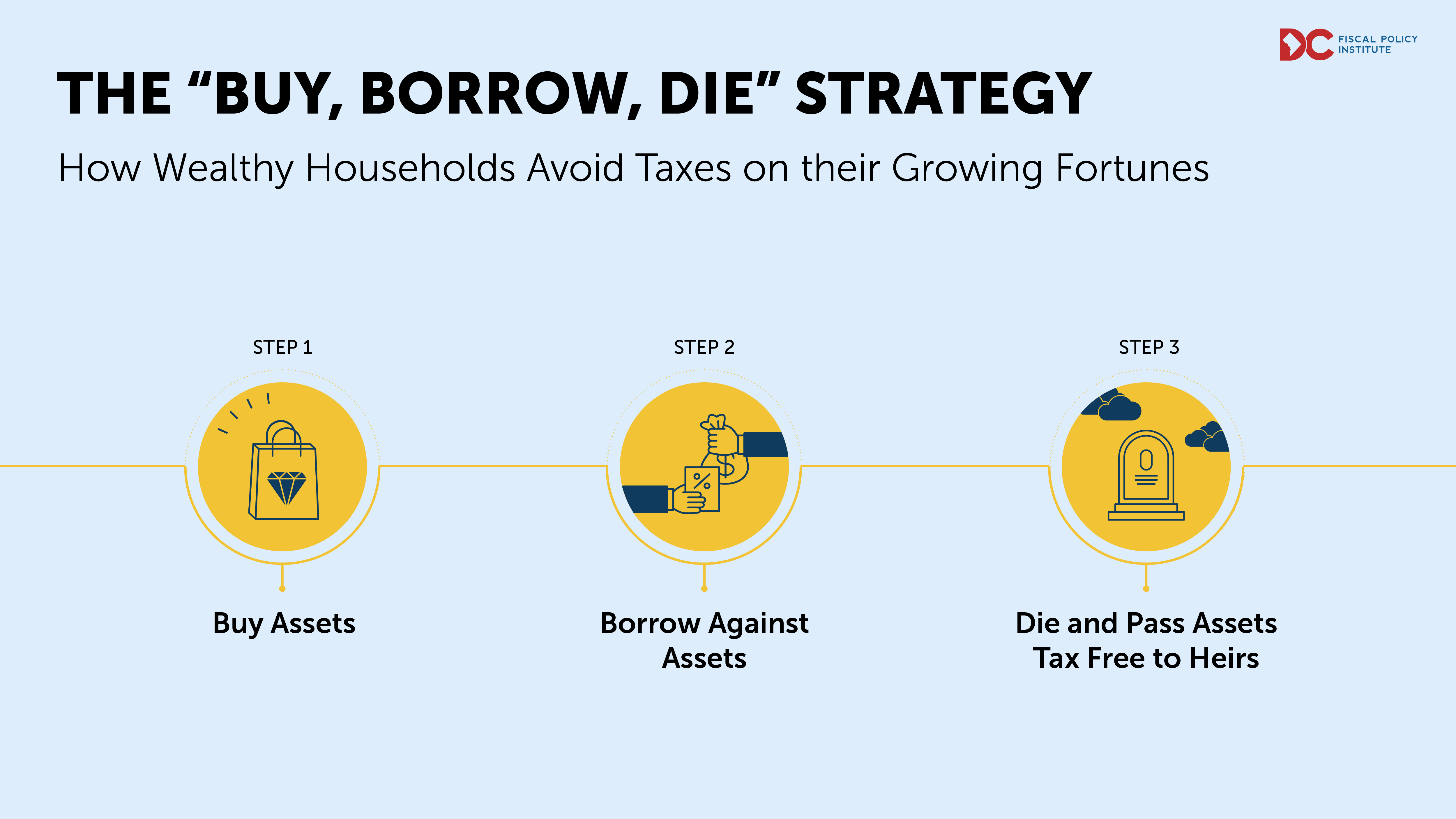
It’s called Buy, Borrow, Die.
And it's how someone can theoretically avoid taxes forever.
1. Buy
First, get assets (stocks, real estate, businesses, etc.). Executives are often given stock from the company they work for (like Apple employees getting partially paid in Apple stock). That receiving of stock is not taxed (until you sell the stock for cash).
2. Borrow
When you need cash, instead of selling those assets, they just borrow against them.
They go to a bank and say “Hey I’ve got $5,000,000 in Apple stock, can I borrow $1,000,000? If I don’t pay it back, you can take the Apple stock.”
Banks love it because it’s low risk.
The rich love it because loans aren’t taxed. They just pay interest on the loan which is way less than tax would be.
Plus since the assets grow faster than the interest rate, they rarely "pay back" the loans in full.
3. Die
When they pass away, all of their assets get a step up in basis. If they bought Apple stock at $1 and it was now worth $150, they should have $149 in gains to pay taxes on.
But inherited stock “steps-up” to the current price eliminating any tax burden… crazy.
The tax system is a bit of a wild one. But it’s not impossible to navigate.
The system rewards ownership.
Salaries pay the bills, but wealth builds freedom. Even small moves like $50 in an index fund put you on the same playing field the wealthy have been winning on for decades.
Pay the government taxes, sure, but don't pay more than you need to!